FEDORA 2nd General Assembly – Budapest

The 2nd General Assembly (GA) Meeting of the FEDORA Project will bring together all
consortium partners in Budapest, Hungary, to review the progress achieved since the 1st
GA Meeting in San Sebastian and to align on the next phase of project activities. Hosted
by the Budapest University of Technology and Economics (BME), the meeting will provide
an overview of the project’s technical, pilot, and strategic advancement, with focused
updates from the Work Packages, discussions on cross-WP integration, pilot preparation,
and impact-oriented activities.
The meeting will also include interactive workshops aimed at strengthening collaboration
across the technical WPs, supporting the demonstrators, and advancing dissemination,
exploitation, standardization, and policy uptake.

Making mobility data interoperable. How FEDORA is helping address the challenge

Making mobility data interoperable remains one of the major challenges in the transition towards smarter and more responsive transport systems. Data is often spread across different organisations, modes, and technical environments, which makes it difficult to combine, compare, and use effectively in real operational settings.

For multimodal traffic management, this is a critical issue. Without interoperability, valuable data from infrastructure, operators, services, and users can remain fragmented, limiting the ability of authorities and mobility actors to respond quickly, plan better, and coordinate actions across the network.

FEDORA is helping address this challenge by developing a more connected and collaborative approach to mobility data. Through its cross-sectoral data space, the project works on interoperable interfaces, common data formats, data cataloguing, and tools that support better data sharing, understanding, and validation. The goal is to make mobility data more accessible, more usable, and more relevant for advanced traffic and network management applications.

In this video, Peter Schmitting, Manager at ERTICO – ITS EUROPE, explains why interoperability matters and how FEDORA is contributing to this effort. His perspective underlines the importance of creating the conditions for data to move more effectively across systems and stakeholders, so that future mobility solutions can become more integrated, adaptive, and impactful.

The role of simulation tools in FEDORA

Simulation tools are a key part of FEDORA’s approach to building more adaptive, resilient, and future-ready multimodal traffic management solutions. They make it possible to test ideas, assess impacts, and explore different mobility scenarios before solutions are applied in real operational environments.

Within the project, FEDORA is developing simulation tools and environments that bring together different transport modes, user behaviours, and traffic management strategies into a more integrated framework. This helps the consortium examine how innovative services and interventions may perform under a wide range of conditions, including complex and changing urban mobility contexts.

These tools are not limited to technical testing. They also support foresight analysis, allowing FEDORA to explore what-if scenarios, evaluate possible future mobility trends, and better understand how different solutions may respond to disruption, demand shifts, and new multimodal services. This creates a stronger basis for decision-making and helps ensure that the solutions developed in the project are not only innovative, but also robust and relevant for real-world use.

In this video, Katerina Vakrinou, Researcher and PhD Candidate at the National Technical University of Athens, explains how these simulation tools and environments support the FEDORA project. Her contribution highlights the importance of modelling, testing, and scenario exploration in shaping mobility solutions that are safer, more efficient, and better aligned with the realities of tomorrow’s transport systems.

FEDORA Scientific Publication: Assessing the impacts of tradable credit schemes through agent-based simulation

Researchers within the Fedora Project have published a new paper titled “Assessing the impacts of tradable credit schemes through agent-based simulation” in Journal of Intelligent Transportation Systems -Technology, Planning, and Operations. The paper presents an integrated simulation framework for evaluating tradable credit schemes (TCS) as an alternative to congestion pricing. By combining agent- and activity-based modeling with multimodal transport simulation, the study captures how individual travel choices, credit trading, and market dynamics interact, providing a more realistic way to assess the effectiveness and practical implementation of TCS. The paper was autored by Renming Liu (DTU),  Dimitrios Argyros (DTU), Yu Jiang (DTU), Moshe Ben-Akiva (MIT),Ravi Seshadri (DTU),and Carlos Lima de Azevedo (#DTU)

Highlights

  • Tradable credits as an alternative to congestion pricing: travelers receive credits, spend them for peak-hour travel, and can buy or sell additional credits.
  • Realistic simulation: thousands of travelers, their daily activities, travel choices, and credit-market decisions are modeled simultaneously.
  • Reduced congestion: simulations confirm the effectiveness of tradable credit schemes in improving network performance and influencing travel behavior.
  • Stable market outcomes: network performance, credit prices, and trading activity stabilize over time, consistent with theoretical expectations.
  • Practical policy design: the framework enables testing of different tradable credit scheme configurations to mitigate undesirable market behavior and support real-world implementation.

Abstract

Tradable credit schemes (TCS) are an alternative to congestion pricing, offering revenue neutrality and the potential to address equity concerns through the credit allocation. Past research on the performance of TCS has largely relied on simplified network and market equilibrium models that may fail to capture the complexities of transportation demand, supply, and credit market interactions. Agent- and activity-based simulation provides a more comprehensive approach by explicitly modeling individual traveler behaviors and market dynamics. This study proposes an integrated simulation framework for TCS implementation within the open-source urban simulation platform SimMobility, featuring: (a) a flexible TCS design that accounts for multiple trips and individual trading behaviors; (b) a simulation framework that models interactions between travelers, the TCS regulator, and the market; (c) TCS optimized using Gaussian Processes and Bayesian Optimization, and (d) simulation experiments on a large-scale mesoscopic multimodal network. Results show that network and market performance stabilize over time, aligning with theoretical TCS properties from network equilibrium models. We confirm the efficiency of TCS in reducing congestion and explore its varied impacts on users, travel behavior, and market dynamics. Our framework allows for designing different TCS configurations and testing their effect in mitigating potentially undesirable trading and market behavior, ultimately contributing to a closer-to-practice design and assessment.


FEDORA Scientific Publication: V2VSL: Infrastructure-Free, Decentralized Variable Speed Limit Control


Researchers within the Fedora Project have published a new paper titled “V2VSL: Infrastructure-Free, Decentralized Variable Speed Limit Control” in Data Sciece for Transportation. The publication explores a fully decentralized, model-free, and infrastructure-free approach to variable speed limit control—V2VSLs. The paper was authored by Kevin Riehl, Davide Pusino, Anastasios Kouvelas, and Michail A. Makridis.


Highlights

  • Assesses performance on  three highway bottleneck scenarios examples.
  • The proposed method achieves significant improvements in traffic states, with up to 15% higher speeds, 5% lower density, and 8% higher flows.
  • V2VSL achieves efficiency gains comparable to centralised VSL systems without the need for similar infrastructure, detailed models, and centralised communication.

Abstract

Traffic congestion is a pertinent issue on highways, with severe consequences on environment, economy, and quality of life. Variable speed limit control can help avoid traffic jams before congestion forms, as vehicles upstream are required to decelerate at times to stop emerging congestion from propagating and expanding. This work proposes a fully decentralized, model-free, and infrastructure-free approach to variable speed limit control—V2VSL—that employs connected vehicles as communication infrastructure, as moving sensors, and as actuators. Dedicated short range communication, consensus algorithm and gossip algorithm protocols, and a Bellman controller are components of this approach. At the example of three highway bottleneck scenarios, performance is assessed by traffic micro-simulations, that show the approach is robust to gaps between platoons and capable of recovering from periods of disconnection. The proposed method achieves significant improvements in traffic states, with up to 15% higher speeds, 5% lower density, and 8% higher flows. These traffic improvements become significant at a compliance rate as low as 25%, making the method potentially viable in near-term mixed traffic environments with partial CAV penetration. V2VSL achieves efficiency gains comparable to centralized VSL systems, but without requiring roadside infrastructure, detailed traffic models, or centralized communication. An open-source implementation and computational results are provided as SUMO simulation with Python on GitHub: https://github.com/DerKevinRiehl/decentralized_vsl/


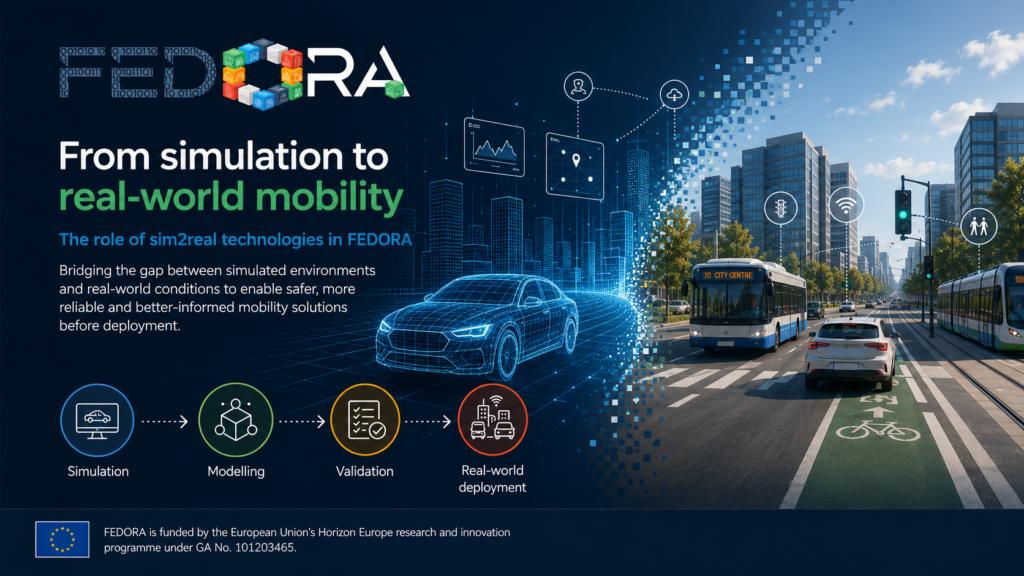
From simulation to real-world mobility. Why sim2real matters in FEDORA​

One of the important challenges in developing new mobility solutions is making sure that what works in a simulated environment can also perform reliably in real-world conditions. This is where sim2real technologies become especially relevant.

In FEDORA, sim2real approaches help connect modelling, simulation, and operational reality. They make it possible to test and refine mobility solutions in controlled digital environments before moving towards deployment. This helps reduce risk, improve reliability, and support more informed decision-making during the development process.

In this video, Katerina Vakrinou, Researcher and PhD Candidate at the National Technical University of Athens, explains the role of sim2real technologies within FEDORA. Her contribution highlights how these approaches can support safer and more robust testing of mobility solutions, while strengthening the link between technical development and practical application.

This perspective is particularly relevant for a project like FEDORA, which aims to support more adaptive, agile, secure, and resilient multimodal traffic management. By helping bridge the gap between simulation and reality, sim2real technologies contribute to building solutions that are better prepared for the complexity of real transport systems.