


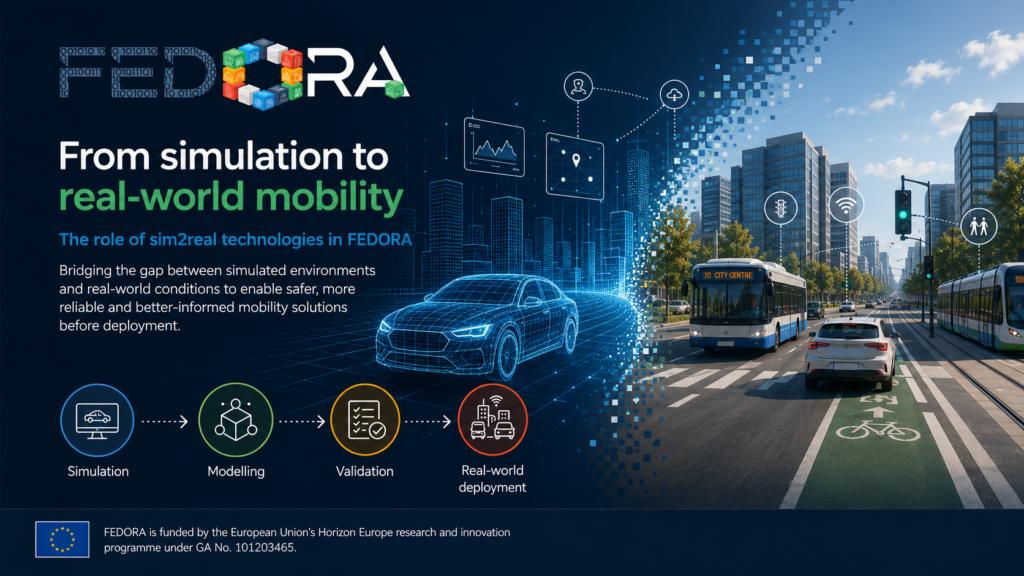
One of the important challenges in developing new mobility solutions is making sure that what works in a simulated environment can also perform reliably in real-world conditions. This is where sim2real technologies become especially relevant.
In FEDORA, sim2real approaches help connect modelling, simulation, and operational reality. They make it possible to test and refine mobility solutions in controlled digital environments before moving towards deployment. This helps reduce risk, improve reliability, and support more informed decision-making during the development process.
In this video, Katerina Vakrinou, Researcher and PhD Candidate at the National Technical University of Athens, explains the role of sim2real technologies within FEDORA. Her contribution highlights how these approaches can support safer and more robust testing of mobility solutions, while strengthening the link between technical development and practical application.
This perspective is particularly relevant for a project like FEDORA, which aims to support more adaptive, agile, secure, and resilient multimodal traffic management. By helping bridge the gap between simulation and reality, sim2real technologies contribute to building solutions that are better prepared for the complexity of real transport systems.