


The FEDORA project was featured at the 2026 ITS World Congress, held from 19 to 23 October in Gangneung, South Korea, as part of discussions on the future of AI-driven traffic management and cooperative transport systems.
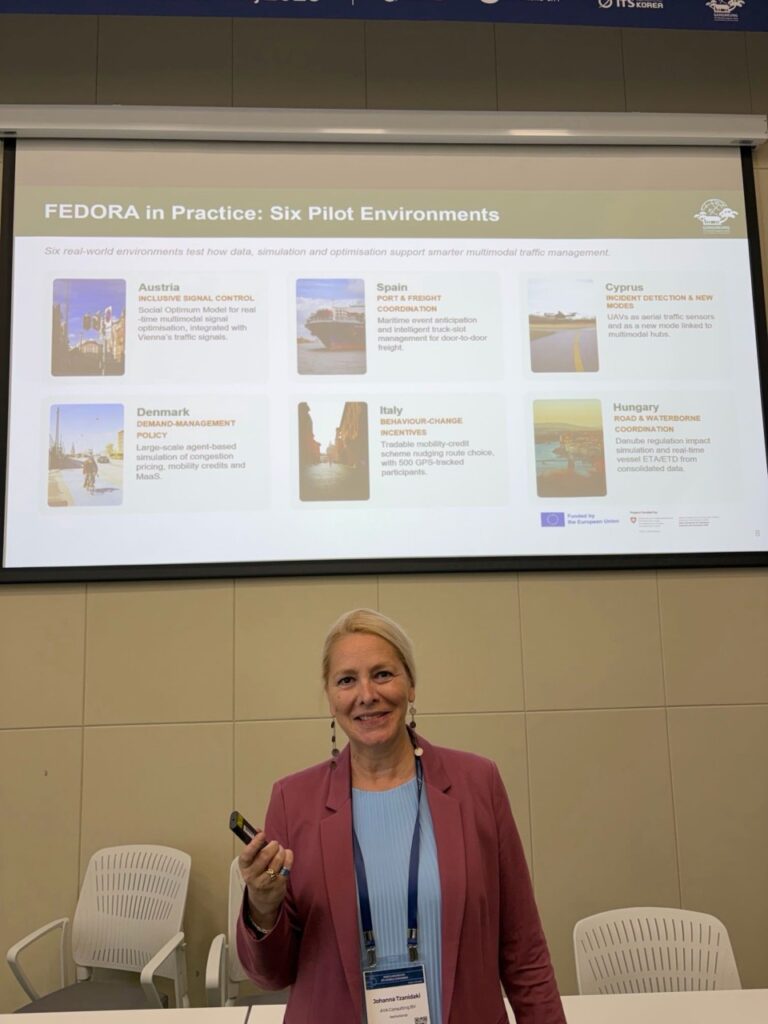
Dr Johanna Tzanidaki, member of FEDORA’s External Advisory Board (EAB), presented the project during Special Interest Session SIS047, “Orchestrating Multi-modal Traffic in the CCAM Era through AI-Driven and Cooperative ITS”, organised and moderated by Dr Yiannis Karaseitanidis from the Institute of Communication and Computer Systems (ICCS).
The session explored how traffic management can move beyond separate, transport-specific systems towards integrated approaches that bring together automated and conventional vehicles, public transport, cycling, micromobility and shared mobility services.
In her presentation, “From managing traffic to conducting multi-modal mobility,” Dr Tzanidaki explained why managing different transport modes requires more than automation. Drawing on several European research projects, she examined how AI and data sharing can help transport stakeholders make informed decisions across complex mobility networks.
Based on Dr Tzanidaki’s presentation, FEDORA played a central role, with particular attention given to its approach to federating data, simulation and optimisation services.
Rather than bringing all mobility data into a single centralised system, FEDORA aims to enable transport authorities, operators and other stakeholders to collaborate while maintaining control over their own data. Through shared data catalogues, agreed access policies and governance arrangements, the project seeks to make information more accessible without compromising data sovereignty.
As Dr Tzanidaki explained, this approach addresses a practical challenge in multimodal traffic management, as organisations often need information from different sources but may be reluctant to share sensitive operational data. By establishing common governance rules, FEDORA aims to build trust between stakeholders and support more informed decisions.
The presentation also introduced FEDORA’s AI-supported decision making and simulation tools, including the Social Optimum Model for traffic signal optimisation in Vienna, agent-based simulation, event anticipation and vessel estimated time of arrival predictions. These solutions aim to help transport operators anticipate changing conditions, assess possible responses and improve the overall performance of mobility networks.
FEDORA’s approach is being tested and simulated across six pilot sites in Europe, covering different transport environments and mobility challenges, including traffic signals, logistics, transport demand, drones and inland waterways. These activities will help assess how the project’s solutions can be applied in different operational settings.