From innovation to impact: how FEDORA’s pilots bring the project to life

FEDORA’s pilot activities are where the project’s ideas, technologies and methods are put to the test in real mobility environments. They provide the practical setting needed to understand how new approaches to multimodal traffic management can respond to local challenges and deliver value for cities, operators and transport users.

In this video, Iona Kirkpatrick, EU Project Manager at the International Road Federation, explains how the pilots contribute to FEDORA’s wider ambitions. By testing the project’s data, optimisation and simulation solutions across different contexts, the pilot sites help identify what works, what needs to be adapted and what is required for successful deployment.

FEDORA’s six pilots cover a diverse range of mobility conditions in Vienna, the Basque Country, Reggio Emilia, Nicosia, Budapest and Denmark. Their activities address topics such as traffic management, logistics, demand management, multimodal services, aerial mobility and inland waterways. This diversity allows the project to examine how its solutions perform across different transport systems, governance structures and levels of digital maturity.

The pilots also support the project’s wider impact by generating evidence that can inform future policy, deployment guidance and replication in other cities and regions. Their results will help ensure that FEDORA’s solutions are not only technically advanced, but also practical, adaptable and relevant to the needs of real mobility networks.

Watch the video to learn how FEDORA’s pilot activities are helping turn innovation into practical progress for the future of multimodal mobility.

Breaking down data silos for better mobility management

Mobility systems depend on data from many different sources, including traffic operators, public transport services, infrastructure managers and local authorities. When this information is stored in separate systems or shared in incompatible formats, it becomes difficult to build a complete picture of what is happening across the transport network.

In this video, Christos Panayiotou, Professor at the KIOS Research and Innovation Center of Excellence at the University of Cyprus, explains how data fragmentation affects the way mobility systems are managed. Limited coordination between platforms can reduce the quality of traffic insights, slow down decision-making and make it harder to respond effectively to changing conditions.

FEDORA is addressing this challenge by creating a more connected framework for multimodal traffic management. The project brings together data, network-management services and simulation tools, helping different systems exchange information and work in a more coordinated way.

Better integration can support a clearer understanding of mobility patterns, improve cooperation between stakeholders and enable more informed traffic-management decisions. It can also make advanced mobility solutions easier to transfer and apply across different cities and transport environments.

Watch the video to learn how FEDORA is working to reduce data fragmentation and support more coordinated, responsive and interoperable mobility systems.

Why standardisation matters for FEDORA’s mobility solutions

Interoperability is essential for the future of multimodal traffic management. Mobility systems rely on data, services and technologies developed by different organisations, often using different formats, interfaces and technical requirements. Without common standards, connecting these elements at scale becomes difficult.

In this video, Peter Schmitting, Manager at ERTICO – ITS Europe, explains the role of standardisation within FEDORA and why it is central to the project’s long-term impact. Standardisation supports the exchange of mobility data, improves compatibility between systems and helps ensure that FEDORA’s solutions can be transferred and deployed across different cities and transport environments.

Through its work on data spaces, network-management services and simulation tools, FEDORA is examining relevant standards, identifying possible gaps and connecting its developments with wider European mobility initiatives. This approach will help make the project’s results more interoperable, replicable and ready for future deployment.

Watch the video to learn how standardisation can support more connected and future-ready mobility solutions across Europe.

Making mobility data interoperable. How FEDORA is helping address the challenge

Making mobility data interoperable remains one of the major challenges in the transition towards smarter and more responsive transport systems. Data is often spread across different organisations, modes, and technical environments, which makes it difficult to combine, compare, and use effectively in real operational settings.

For multimodal traffic management, this is a critical issue. Without interoperability, valuable data from infrastructure, operators, services, and users can remain fragmented, limiting the ability of authorities and mobility actors to respond quickly, plan better, and coordinate actions across the network.

FEDORA is helping address this challenge by developing a more connected and collaborative approach to mobility data. Through its cross-sectoral data space, the project works on interoperable interfaces, common data formats, data cataloguing, and tools that support better data sharing, understanding, and validation. The goal is to make mobility data more accessible, more usable, and more relevant for advanced traffic and network management applications.

In this video, Peter Schmitting, Manager at ERTICO – ITS EUROPE, explains why interoperability matters and how FEDORA is contributing to this effort. His perspective underlines the importance of creating the conditions for data to move more effectively across systems and stakeholders, so that future mobility solutions can become more integrated, adaptive, and impactful.

The role of simulation tools in FEDORA

Simulation tools are a key part of FEDORA’s approach to building more adaptive, resilient, and future-ready multimodal traffic management solutions. They make it possible to test ideas, assess impacts, and explore different mobility scenarios before solutions are applied in real operational environments.

Within the project, FEDORA is developing simulation tools and environments that bring together different transport modes, user behaviours, and traffic management strategies into a more integrated framework. This helps the consortium examine how innovative services and interventions may perform under a wide range of conditions, including complex and changing urban mobility contexts.

These tools are not limited to technical testing. They also support foresight analysis, allowing FEDORA to explore what-if scenarios, evaluate possible future mobility trends, and better understand how different solutions may respond to disruption, demand shifts, and new multimodal services. This creates a stronger basis for decision-making and helps ensure that the solutions developed in the project are not only innovative, but also robust and relevant for real-world use.

In this video, Katerina Vakrinou, Researcher and PhD Candidate at the National Technical University of Athens, explains how these simulation tools and environments support the FEDORA project. Her contribution highlights the importance of modelling, testing, and scenario exploration in shaping mobility solutions that are safer, more efficient, and better aligned with the realities of tomorrow’s transport systems.

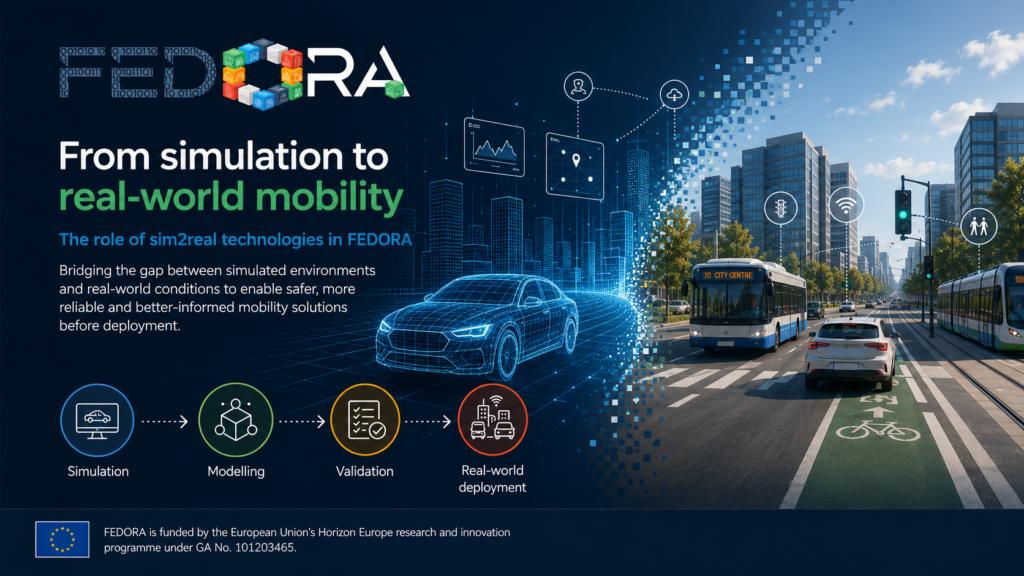
From simulation to real-world mobility. Why sim2real matters in FEDORA​

One of the important challenges in developing new mobility solutions is making sure that what works in a simulated environment can also perform reliably in real-world conditions. This is where sim2real technologies become especially relevant.

In FEDORA, sim2real approaches help connect modelling, simulation, and operational reality. They make it possible to test and refine mobility solutions in controlled digital environments before moving towards deployment. This helps reduce risk, improve reliability, and support more informed decision-making during the development process.

In this video, Katerina Vakrinou, Researcher and PhD Candidate at the National Technical University of Athens, explains the role of sim2real technologies within FEDORA. Her contribution highlights how these approaches can support safer and more robust testing of mobility solutions, while strengthening the link between technical development and practical application.

This perspective is particularly relevant for a project like FEDORA, which aims to support more adaptive, agile, secure, and resilient multimodal traffic management. By helping bridge the gap between simulation and reality, sim2real technologies contribute to building solutions that are better prepared for the complexity of real transport systems.