Who should get priority when our roads become congested?
Traditional traffic management focuses primarily on reducing delays and improving traffic flow. Yet not every journey has the same urgency, and treating all travellers equally does not necessarily lead to fair outcomes. Within the EU-funded FEDORA project, researchers at ETH Zurich are exploring how innovative incentive mechanisms and advanced simulation tools can make urban mobility more efficient, flexible and fair.
Rethinking Traffic Prioritisation and Incentives Through Artificial Currencies
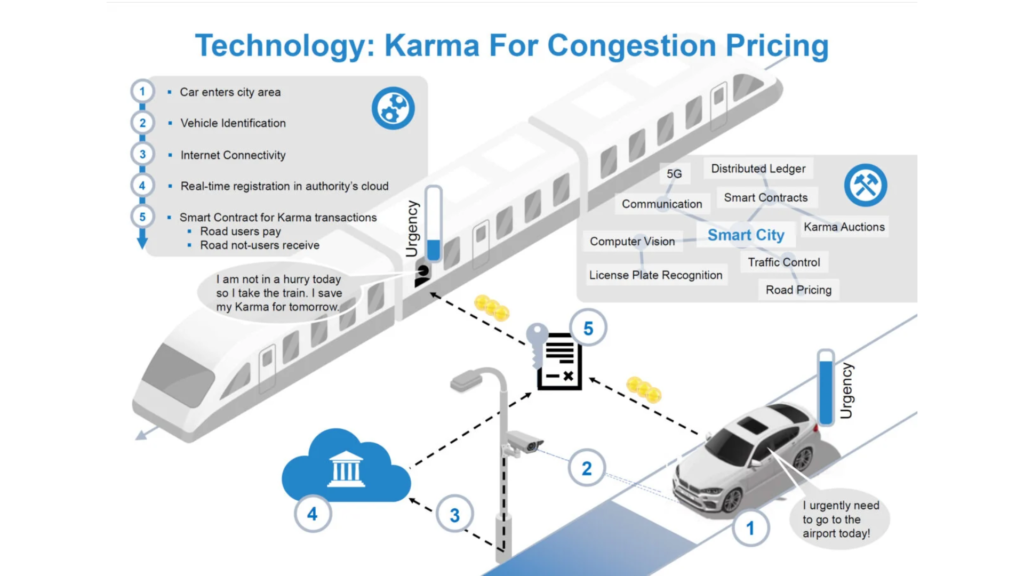
One focus of ETH Zurich’s research is the development of new approaches to managing traffic demand and allocation of supply. Conventional congestion pricing can help regulate road use, but often faces public resistance due to fairness concerns. Could alternative approaches offer a better balance?
To investigate this question, ETH Zurich is exploring Karma mechanisms, which use non-monetary credits to coordinate how travellers share limited road capacity. By combining game theory with multi-agent reinforcement learning, researchers investigate how individual decisions and interactions can lead to more efficient and equitable outcomes.
Another promising concept is the Urban Priority Pass, which allows travellers with particularly urgent needs to receive priority at traffic signals. Using a Manhattan-inspired case study, ETH Zurich has investigated how such prioritisation can work and how markets could allocate priority according to different travellers’ needs.
From Research Concepts to Open-Source Simulation
Developing innovative traffic management strategies is only the first step. How can we test them before introducing them into real cities?
To address this challenge, ETH Zurich has developed and released a first prototype of FEDORA’s modular simulation platform, publicly available on GitHub under the GNU General Public License.
The platform is designed to connect different traffic simulation environments with optimisation and control methods through reusable interfaces. Its initial prototype demonstrates the Priority Pass concept and includes a prototypic simulation demonstrator based on FEDORA’s Vienna pilot.
By making the framework modular and openly accessible, ETH Zurich aims to facilitate experimentation, reproducibility and collaboration across the FEDORA consortium and the wider research community.
Looking ahead
Together, these activities bring FEDORA closer to a future in which traffic management considers not only how efficiently vehicles move, but also how fairly limited transport resources are shared.
This entry is part of the FEDORA Blog series, where FEDORA partners share their insights from working in the project. This contribution has been provided by FEDORA partner ETH Zurich.