Why cities and public authorities matter to the future of mobility

Cities and public authorities are at the centre of the transition towards smarter, safer and more sustainable mobility. They understand local transport challenges, shape policy priorities and play a key role in turning innovative ideas into solutions that work in real urban environments.

In this video, Iona Kirkpatrick, EU Project Manager at the International Road Federation, shares her message for cities and public authorities on the importance of FEDORA and the value of their involvement in the project.

FEDORA is developing new approaches to multimodal traffic management by connecting data, optimisation services and simulation tools within a shared framework. This work can support authorities in understanding complex mobility patterns, testing different scenarios and making more informed decisions before introducing changes across transport networks.

The participation of cities is essential to ensure that these solutions respond to real needs, reflect different local conditions and can be transferred to other regions. Their knowledge also helps the project consider the regulatory, operational and organisational factors that influence how new mobility solutions are adopted.

Watch the video to hear why cooperation with cities and public authorities is vital for shaping practical, adaptable and future-ready mobility systems.

From innovation to impact: how FEDORA’s pilots bring the project to life

FEDORA’s pilot activities are where the project’s ideas, technologies and methods are put to the test in real mobility environments. They provide the practical setting needed to understand how new approaches to multimodal traffic management can respond to local challenges and deliver value for cities, operators and transport users.

In this video, Iona Kirkpatrick, EU Project Manager at the International Road Federation, explains how the pilots contribute to FEDORA’s wider ambitions. By testing the project’s data, optimisation and simulation solutions across different contexts, the pilot sites help identify what works, what needs to be adapted and what is required for successful deployment.

FEDORA’s six pilots cover a diverse range of mobility conditions in Vienna, the Basque Country, Reggio Emilia, Nicosia, Budapest and Denmark. Their activities address topics such as traffic management, logistics, demand management, multimodal services, aerial mobility and inland waterways. This diversity allows the project to examine how its solutions perform across different transport systems, governance structures and levels of digital maturity.

The pilots also support the project’s wider impact by generating evidence that can inform future policy, deployment guidance and replication in other cities and regions. Their results will help ensure that FEDORA’s solutions are not only technically advanced, but also practical, adaptable and relevant to the needs of real mobility networks.

Watch the video to learn how FEDORA’s pilot activities are helping turn innovation into practical progress for the future of multimodal mobility.

Breaking down data silos for better mobility management

Mobility systems depend on data from many different sources, including traffic operators, public transport services, infrastructure managers and local authorities. When this information is stored in separate systems or shared in incompatible formats, it becomes difficult to build a complete picture of what is happening across the transport network.

In this video, Christos Panayiotou, Professor at the KIOS Research and Innovation Center of Excellence at the University of Cyprus, explains how data fragmentation affects the way mobility systems are managed. Limited coordination between platforms can reduce the quality of traffic insights, slow down decision-making and make it harder to respond effectively to changing conditions.

FEDORA is addressing this challenge by creating a more connected framework for multimodal traffic management. The project brings together data, network-management services and simulation tools, helping different systems exchange information and work in a more coordinated way.

Better integration can support a clearer understanding of mobility patterns, improve cooperation between stakeholders and enable more informed traffic-management decisions. It can also make advanced mobility solutions easier to transfer and apply across different cities and transport environments.

Watch the video to learn how FEDORA is working to reduce data fragmentation and support more coordinated, responsive and interoperable mobility systems.

Why standardisation matters for FEDORA’s mobility solutions

Interoperability is essential for the future of multimodal traffic management. Mobility systems rely on data, services and technologies developed by different organisations, often using different formats, interfaces and technical requirements. Without common standards, connecting these elements at scale becomes difficult.

In this video, Peter Schmitting, Manager at ERTICO – ITS Europe, explains the role of standardisation within FEDORA and why it is central to the project’s long-term impact. Standardisation supports the exchange of mobility data, improves compatibility between systems and helps ensure that FEDORA’s solutions can be transferred and deployed across different cities and transport environments.

Through its work on data spaces, network-management services and simulation tools, FEDORA is examining relevant standards, identifying possible gaps and connecting its developments with wider European mobility initiatives. This approach will help make the project’s results more interoperable, replicable and ready for future deployment.

Watch the video to learn how standardisation can support more connected and future-ready mobility solutions across Europe.

FEDORA Scientific Publication: Towards Fair Roads–Manifesto for Fair Traffic Engineering

Researchers within the Fedora Project have published a new paper titled “Towards Fair Roads–Manifesto for Fair Traffic Engineering” in Sustainability. The study challenges narrowly specified, efficiency-oriented engineering formulations in traffic engineering, establishes a link to modern fairness theories, and highlights the importance of fairness when allocating scarce, public good, mobility resources between road users. The paper was authored by Keving Riehl (ETH Zurich), Anastasios Kouvelas (ETH Zurich), and Michail A. Makridis (ETH Zurich)

Highlights

  • Advocates a new paradigm of for traffic engineering based on fairness rather than efficiency
  • Fills a gap in the relevant literature and establishes a framework to assess fairness in a systematic way.
  • Proposes a distributive, quantitative, ideology-free, and pragmatic fairness framework for infrastructural and behavioural traffic control systems showcased and demonstrated in two case studies

Abstract

Traffic engineering aims to control infrastructure and population behaviour to achieve optimal usage of road networks. Fairness is fundamental to stimulate cooperation in large populations, and plays an important role in traffic engineering, as it increases the well-being of users, improves driving safety by rule adherence, and overcomes public resistance at legislative implementation. Despite the importance of fairness, only a few works have translated fairness into the transportation domain, with a focus on transportation planning rather than traffic engineering. Moreover, existing works in traffic engineering discuss fairness superficially and insufficiently, focussing on only a few definitions. The mission of this work is (i) to challenge narrowly specified, efficiency-oriented engineering formulations in traffic engineering, (ii) to establish a link to modern fairness theories, and (iii) to highlight the importance of fairness when allocating scarce, public good, mobility resources between road users. To achieve this, a mode-agnostic, distributive fairness framework for mobility resource allocation is proposed. It serves when designing traffic engineering solutions, and convinces in public debates with a useful, argumentative tool-set to confront equity considerations. Ultimately, this enables systematic research and design of fairness-informed control systems, demonstrated by three case studies on signalized intersection management and static road pricing.
 

FEDORA Scientific Publication: When Fairness Backfires: A Chronoceptive Design Approach to Intelligent Transportation Systems

Researchers within the Fedora Project have published a new paper titled “When Fairness Backfires: A Chronoceptive Design Approach to Intelligent Transportation Systems” in Smart Cities. The paper investigates how chronoception—the subjective perception of time—affects user acceptance of ITS control strategies and how signal design can be adapted to reduce perceived delays. The paper was authored by Keving Riehl (ETH Zurich), Linghang Sun (ETH Zurich), Anastasios Kouvelas (ETH Zurich), and Michail A. Makridis (ETH Zurich)

Highlights

  • Chronoceptive ramp metering designs significantly improve user acceptance and perceived fairness compared with standard ramp metering, despite providing the same underlying traffic-control benefits.
  • Shorter signal cycles, countdown timers, and three-phase signals reduce perceived waiting times and increase preference for ramp metering, with the 45 s cycle design achieving the highest acceptance rates.
  • Intelligent transportation systems should be designed not only for objective efficiency but also for users’ subjective perception of time, as perceived benefits strongly influence acceptance and compliance.
  • Chronoceptive design offers a practical human-centred framework for reducing public resistance to traffic-control measures and improving the real-world effectiveness of ITS deployment

Abstract

Intelligent transportation systems (ITSs) and traffic control promise substantial efficiency and safety improvements but frequently face public resistance and driver compliance issues. Many drivers perceive such control measures as unfair or unnecessary, despite measurable system-wide benefits. This study investigates how chronoception—the subjective perception of time—affects user acceptance of ITS control strategies and how signal design can be adapted to reduce perceived delays. We introduce a chronoceptive design framework that integrates insights from cognitive psychology into traffic-control design. Using ramp metering as a case study, we conduct virtual experience stated preference experiments with 101 participants, comparing standard and chronoceptive ramp metering designs featuring shorter signal cycles, three-phase lights, and countdown timers. The results show that chronoceptive signal designs significantly improve user acceptance (by up to 12%) and reduce perceived waiting times, despite identical or slightly longer objective travel times. These findings reveal a systematic bias between factual and perceived benefits and highlight the potential of chronoceptive design to enhance compliance and fairness perception. This study contributes a new human-centred design paradigm for traffic control that aligns objective performance with user perception and outlines how chronoception and perceived fairness can be operationalised in traffic control. 
 

One Year of FEDORA: Building the Foundations for the Future of Multimodal Mobility

Twelve months after its launch, the Horizon Europe project FEDORA has reached an important milestone. Over the past year, the consortium has transformed ambitious concepts into tangible results, establishing the technical, organisational and collaborative foundations needed to develop the next generation of multimodal traffic management solutions.

One of the project’s most significant achievements has been the creation of the FEDORA cross-sectoral Data Space. During its first year, partners developed the architecture for secure and interoperable data sharing, deployed a public mobility data catalogue, implemented automated metadata harvesting and multilingual translation, and introduced an AI-powered assistant to help users discover and understand available datasets. The project has also achieved its first successful live exchange of mobility data between consortium partners, demonstrating that trusted data sharing can become a reality across organisational boundaries.

FEDORA has also made substantial progress in developing its Integrated Platform, which will connect the project’s diverse technical components into a unified ecosystem. The platform architecture has been defined, creating the basis for integrating data services, optimisation tools and simulation capabilities developed by partners across Europe.

Simulation and modelling have been another major area of progress. During the first year, partners advanced multimodal traffic simulation engines, agent-based behavioural models and innovative traffic management controllers covering applications such as mobility credits, congestion pricing, Mobility as a Service and automated mobility services. At the same time, new Sim2Real methodologies and foresight analysis tools have been developed to help cities evaluate mobility strategies before implementing them in real-world environments.

The project’s six pilot sites have also moved from planning to implementation. Through Living Lab activities and co-creation workshops, local authorities and stakeholders have worked alongside the consortium to define use cases, identify operational requirements and shape future demonstrations. This collaborative process ensures that FEDORA’s solutions respond directly to the needs of cities, transport operators and citizens.

Beyond technology development, the project has established strong foundations for responsible innovation and long-term impact. Governance models are being developed to support collaborative decision-making across stakeholders, while dissemination activities have expanded through scientific publications, conference participation, workshops and growing engagement with the wider European mobility community. The consortium has also begun defining exploitation pathways to ensure that FEDORA’s innovations can continue creating value beyond the lifetime of the project.

The first year has demonstrated the strength of collaboration across the consortium. With key milestones achieved, technical architectures established and the first integrated solutions already operational, FEDORA is now entering a new phase focused on integration, validation and demonstration.

As work continues, the project remains committed to delivering practical, data-driven solutions that help European cities manage increasingly complex transport systems while supporting more sustainable, efficient and resilient mobility for all.


FEDORA partners meet in Budapest for the second General Assembly

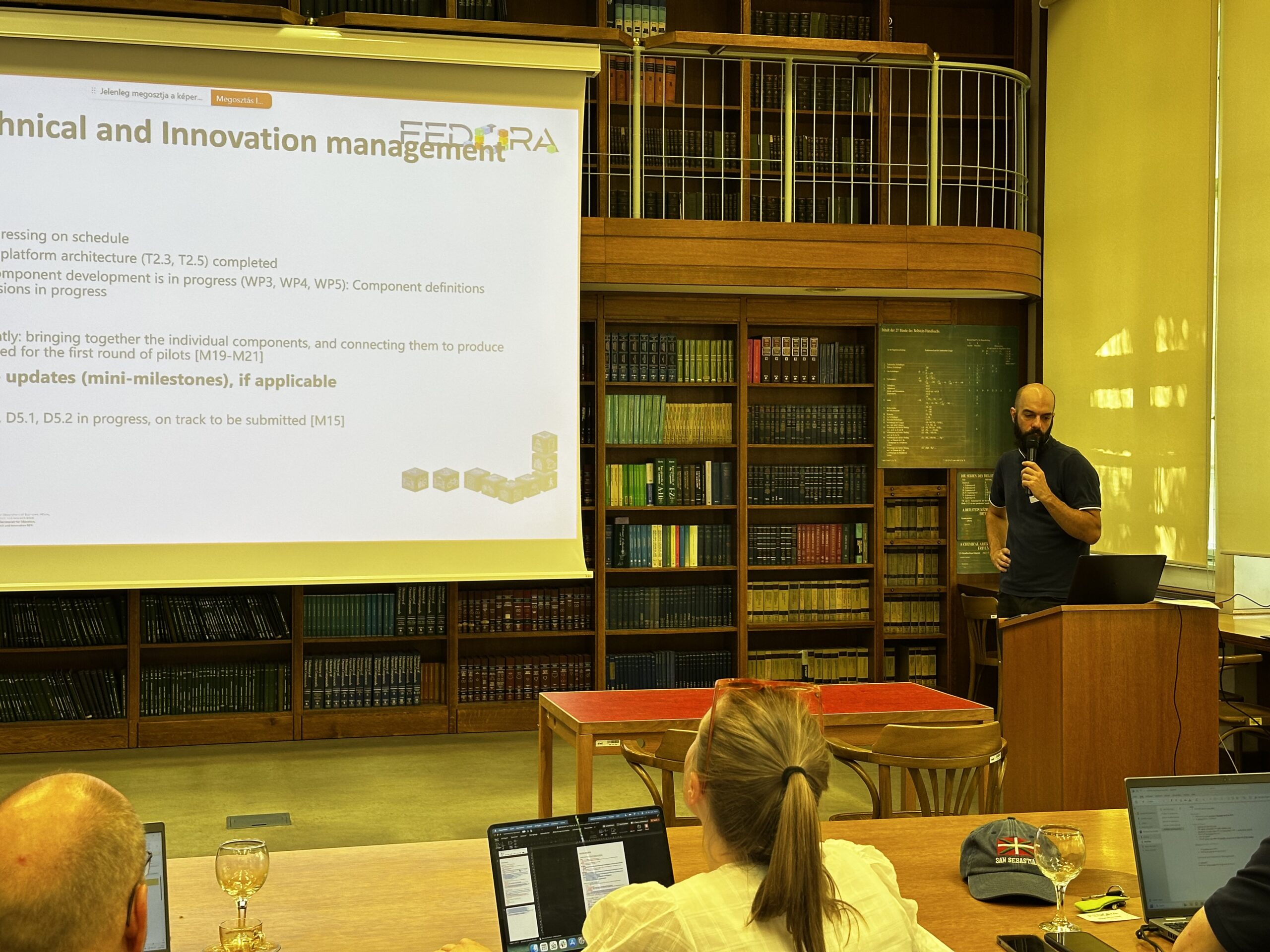
The FEDORA consortium came together in Budapest for its second General Assembly, marking an important milestone as the project enters its second year. Hosted by Budapest University of Technology and Economics (BME), the two-day meeting brought together partners from across Europe to review progress, demonstrate technical developments and plan the next phase of implementation.

With the project advancing steadily, the General Assembly provided an opportunity for researchers, technology providers, public authorities and pilot representatives to exchange knowledge and strengthen collaboration across work packages.

A key focus of the meeting was the progress achieved across FEDORA’s technical developments. Partners presented updates on the project’s cross-sectoral Data Space, integrated platform, governance framework and multimodal simulation environment, highlighting the work completed during the first year and outlining the roadmap towards the first pilot demonstrations.

One of the meeting’s highlights was the live demonstration of FEDORA’s evolving Data Space. Partners showcased the first successful cross-partner exchange of mobility data using Eclipse Dataspace Components (EDC), illustrating how data can be securely shared between organisations while maintaining data sovereignty. Demonstrations also included the project’s public data catalogue and AI-powered chatbot, designed to simplify the discovery and understanding of mobility datasets.

The General Assembly also provided an opportunity to review progress in the six pilot sites. Discussions focused on stakeholder engagement, Living Lab activities and the refinement of pilot use cases, ensuring that the technologies under development remain aligned with the operational needs of cities and transport authorities.

Interactive workshops encouraged partners to contribute directly to the project’s next steps. Governance sessions explored stakeholder mapping and the development of a multi-level governance framework, while technical workshops gathered feedback on the Data Space components and AI tools. A dedicated exploitation workshop helped partners identify pathways for maximising the long-term impact of FEDORA’s key innovations.

Communication, dissemination and collaboration were also high on the agenda. Partners reviewed upcoming scientific publications, conferences and stakeholder engagement activities, while discussing opportunities to strengthen cooperation with related European initiatives, including the CIVITAS community and the Horizon Results Booster programme.

Looking ahead, the consortium will focus on integrating the project’s technical components, delivering the next series of milestones and preparing the first round of pilot demonstrations. As FEDORA moves from design and development towards real-world validation, the General Assembly reaffirmed the consortium’s shared commitment to delivering innovative solutions for smarter, more sustainable multimodal traffic management across Europe.

Making mobility data interoperable. How FEDORA is helping address the challenge

Making mobility data interoperable remains one of the major challenges in the transition towards smarter and more responsive transport systems. Data is often spread across different organisations, modes, and technical environments, which makes it difficult to combine, compare, and use effectively in real operational settings.

For multimodal traffic management, this is a critical issue. Without interoperability, valuable data from infrastructure, operators, services, and users can remain fragmented, limiting the ability of authorities and mobility actors to respond quickly, plan better, and coordinate actions across the network.

FEDORA is helping address this challenge by developing a more connected and collaborative approach to mobility data. Through its cross-sectoral data space, the project works on interoperable interfaces, common data formats, data cataloguing, and tools that support better data sharing, understanding, and validation. The goal is to make mobility data more accessible, more usable, and more relevant for advanced traffic and network management applications.

In this video, Peter Schmitting, Manager at ERTICO – ITS EUROPE, explains why interoperability matters and how FEDORA is contributing to this effort. His perspective underlines the importance of creating the conditions for data to move more effectively across systems and stakeholders, so that future mobility solutions can become more integrated, adaptive, and impactful.

The role of simulation tools in FEDORA

Simulation tools are a key part of FEDORA’s approach to building more adaptive, resilient, and future-ready multimodal traffic management solutions. They make it possible to test ideas, assess impacts, and explore different mobility scenarios before solutions are applied in real operational environments.

Within the project, FEDORA is developing simulation tools and environments that bring together different transport modes, user behaviours, and traffic management strategies into a more integrated framework. This helps the consortium examine how innovative services and interventions may perform under a wide range of conditions, including complex and changing urban mobility contexts.

These tools are not limited to technical testing. They also support foresight analysis, allowing FEDORA to explore what-if scenarios, evaluate possible future mobility trends, and better understand how different solutions may respond to disruption, demand shifts, and new multimodal services. This creates a stronger basis for decision-making and helps ensure that the solutions developed in the project are not only innovative, but also robust and relevant for real-world use.

In this video, Katerina Vakrinou, Researcher and PhD Candidate at the National Technical University of Athens, explains how these simulation tools and environments support the FEDORA project. Her contribution highlights the importance of modelling, testing, and scenario exploration in shaping mobility solutions that are safer, more efficient, and better aligned with the realities of tomorrow’s transport systems.